Chủ Nhật, 18 tháng 1, 2015

Benda: Harpsichord Concertos


Georg Anton Benda (1722-1795), who was attached to the Berlin court initially under Frederick Great, made his mark as an innovative opera composer. However, there’s little if any innovation on display in these harpsichord concertos, which are considerably less developed in style than the contemporaneous work of Mozart or either of the Haydn brothers. Aside from the virtuoso quality of some of the keyboard writing, these concertos display some typical galant mannerisms along with the Baroque tendency to sustain a single mood during a movement, if not throughout the whole piece. But within that constraint there is a lot of variety among these four works.


The most dazzling is the F major concerto, with brisk toccata-like writing that recalls Domenico Scarlatti. The F minor concerto is turbulent, and although I wouldn’t go so far as to call it a “Sturm und Drang” piece, it does have a sense of struggle that presages Beethoven. The B minor concerto has its share of struggle as well, but it relaxes into a slow movement with a lovely melody. The G major concerto is the sunniest and in many ways the simplest of the lot. One idiosyncrasy is Benda’s tendency to end movements abruptly, which happens at one point or another in nearly all these works.

The performances are delightful. The harpsichord and the string orchestra are well balanced, picked up fairly closely but with a nice sense of hall ambience in the surround program. The 1992 harpsichord is bright without being strident, assertive without being harsh. CPO’s prominent pick-up conveys some of the sounds of its mechanism, enough to add a percussion effect in vigorous moments. Sabine Bauer’s solo work is alert, brisk, and playful, reveling in the music’s more challenging passages. La Stagione Frankfurt comprises only 13 players but never sounds stressed or scrawny. The music itself won’t make any “Essential Classics” lists, but the disc is a pleasurable listen all the way through.

- See more at: http://www.classicstoday.com/review/review-12247/#sthash.ZhIIbj3g.dpuf

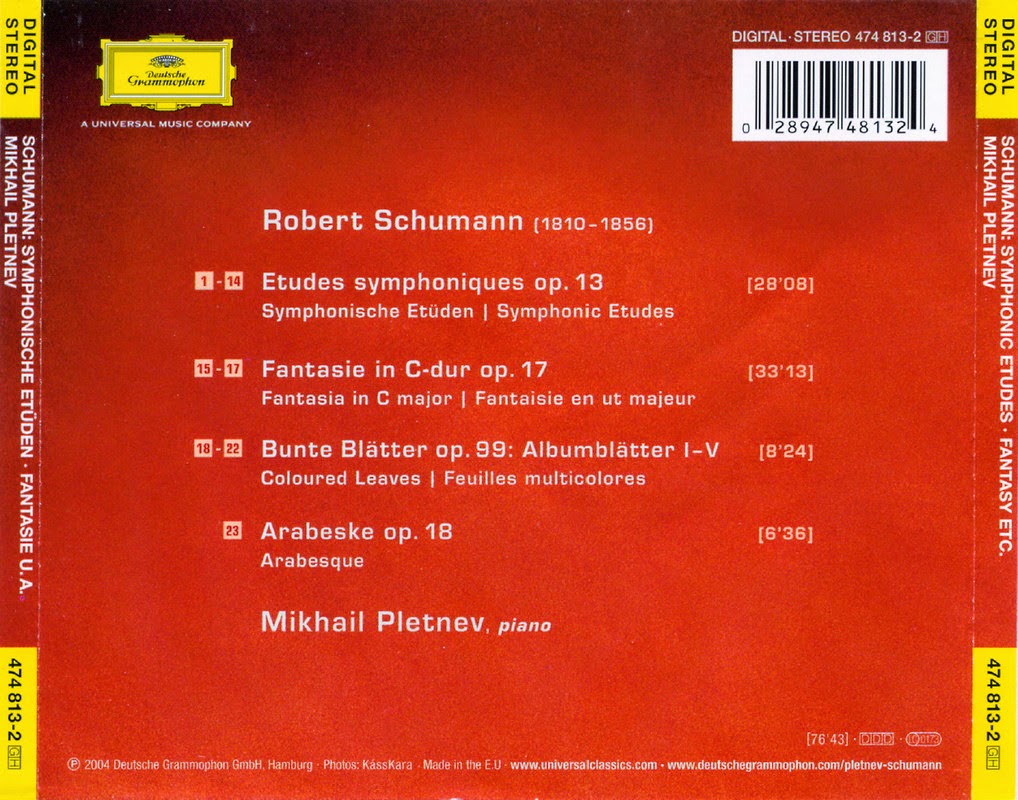
Schumann: Piano Music


". . . this is one of today's master pianists, and while his effortless virtuosity cannot fail to draw attention, it is used above all to realise a vision of the music which is unconventional but genuine. The "Etudes symphoniques" are strong and massive, and the principal tune of the "Arabesque" is caressed so sweetly that the notes flit by like shadows . . . 'fantastical throughout'." --BBC Music Magazine, January 2005


"Among the younger generation of concert pianists, few have a more vivid imagination than Mikhail Pletnev. The Russian artist also has the capacity to connect the contrasting moods of Schumann's "Etudes symphoniques" to create a work of overwhelming emotional depth. His playing here and in the impassioned Fantaisie is never routine, always rich in expression and subtle in shading. Pletnev's inspired music is complemented by Deutsche Grammophon's warm recorded sound." --Music Week (London), May 2004

"Anyone lucky enough to have heard the recital by Mikhail Pletnev that opened Lincoln Center's Great Performers series last fall knows he is the keyboard's reigning mystic. His new album, "Pletnev Plays Schumann," reveals him at his brooding best." --Daily News (New York), 27. March 2005

Busoni: Clarinet Chamber Music


The son of an Italian musician father and a German pianist mother, Ferruccio Busoni represented a remarkable synthesis of two differing attitudes to music at this time, while winning an outstanding reputation as a piano virtuoso. Busoni composed operas, including Turandot and Doktor Faust, a series of orchestral works, including a Piano Concerto that also uses a male chorus in the finale, and various pieces of chamber music. 


Concert Favorites


Sir Adrian Boult’s advocacy of English music perhaps overshadowed his protean abilities to secure stylish performances in a much wider range of repertoire. The English conductorwas born on April 8th, 1889 in Chester and died on February 22nd, 1983 in London.


Thứ Bảy, 17 tháng 1, 2015

Prokofiev & Ravel: Piano Concertos


“She is a wholly exceptional artist, the possessor of a fabulous technique, and her musical understanding is a very rare quality...Her playing of the Ravel Concerto is breathtaking...I am sure that this is just what Ravel wanted - it really crackles with electricity, her passagework as light and as brilliant as quicksilver...These concertos are very different works, but this young pianist has the measure of them both - in spades.” --International Record Review, April 2011


Sergei Prokofiev’s Piano Concerto No. 2 in G Minor was written in 1913 and dedicated to a friend of the composer who had recently committed suicide. It was revised in 1923, and this version remains one of the most technically challenging works in the standard repertoire. Following a highly successful tour of America as piano soloist, Maurice Ravel finished his Piano Concerto in G Major in 1931. The concerto is heavily influenced by jazz, which at the time was highly popular in Paris as well as the USA.

“The Prokofiev concerto can sound flashy and empty, but Vinnitskaya's more fantastical and demented view reveals its hidden depths. She rips through the fiercely tough first-movement cadenza like a force of nature...Exemplary, high-wire Prokofiev.” --Classic FM Magazine, April 2011 ****

“Anna Vinnitskaya has a dry, clear sound which I think [Prokofiev] would rather have admired...Gilbert Varga's direction is precise and detailed...I certainly want to hear more from this phenomenally equipped pianist.” --BBC Music Magazine, Febuary 2011 ****

“The opening whiplash of Ravel's "Piano Concerto in G major" portends the virtuosic fireworks to follow...But the concerto's real achievement lies in the final two movements, whose fantastical twists grow more unsettling by the minute.” --The Independent, 28th January 2011 ***

Ballet For A Lonely Violinist


“Vadim Gluzman and Angela Yoffe, an impressive well matched husband-and-wife team, give a powerful account of the 1968 Shostakovich Sonata. This performance rises to its demands - extremes of tone and virtuoso intensity - the central Allegretto projecting an atmosphere of glittering ferocity. The Jazz Suite No 1 of 1934... takes us back to a very different Shostakovich: the wit may be sardonic but the mood remains light-hearted and upbeat. The Sonata, Auerbach's response to the events of 9/11, is on a far grander scale, with big, even melodramatic gestures. It's a well made piece, imaginatively cast for the two instruments and with some beautiful, inspiring moments...” --Gramophone Magazine, September 2006


“…the centre of gravity of this recital is a magnificently eloquent and understanding performance of Shostakovich's Violin Sonata, which as the years pass comes to seem one of the greatest of his late works. …Gluzman and Yoffe infuse the music with an expressive glow that transcends its innate austerity.” --BBC Music Magazine, March 2007 *****

Bach, J S: Brandenburg Concertos Nos. 1-6 BWV1046-1051 (complete)


“The excitement is palpable, reflected in smiling glances between the players, bodies swaying through musical suspensions, a sense of uninhibited joy… The playing is stylish throughout: ornaments are apt, all the more telling for their restraint; trills are paced to match mood, languid in slow movements, sparkling in allegros.” --BBC Music Magazine, April 2009

Gramophone Awards 2011 Shortlisted - Baroque Instrumental


“Here Claudio Abbado is gambolling among the Brandenburg Concertos in this straightforward TV-style concert film, recorded in the classic 19th-century opera house at Reggio Emilia during an Italian tour in spring 2007. The orchestra is at first glance a curious gathering, mixing 'Baroque' players such as violinist Giuliano Carmignola and harpsichordist Ottavio Dantone with 'modern' names such as trumpeter Reinhold Friedrich and 'un-Baroque' recorder-player Michala Petri. Furthermore, a look round the instruments reveals mostly modern models, some hybrids (for instance Jacques Zoon's wooden, multi-keyed flute) and a sprinkling of Baroque bows. Mind you, most younger players these days are well versed in Baroque style whatever they play on, and the tenor of these performances is firmly consistent with current ideas of what Baroque music ought to sound like.” --Gramophone Classical Music Guide, 2010

“This new recording of the Brandenburg Concertos exhibits all the virtues that one associates with Claudio Abbado: clarity, lucidity, balance, a sense of proportion, and, above all, an indefinable yet audible 'oneness' with the music. Dionysus is present in these performances, but he subsumed within their underlying Apollonian quality.” --International Record Review, April 2011
 
“Does the world need another set of Brandenburgs? Yes, when they are as freshly minted and as adventurously sonorous as this marvellous set...Abbado leads supple, imaginative readings; a great deal of the strong character is provided by his leader, violinist Giuliano Carmignola, and there is a brilliant harpsichord solo from Ottavio Dantone in the fifth concerto.” --The Observer, 13th March 2011

“the audio-only experience draws out a super-contented gestural world which had only intermittently communicated itself before...The hallmark of this set is the ambition to create lithe, beautiful and elegant statements in which witty, sophisticated dialogues are carried off within a heady textural landscape...The Fifth spins like a happy top...These are life-affirming live performances...which glide effortlessly on to the high table.” --Gramophone Magazine, June 2011

“Conducting J. S. Bach isn’t Abbado’s usual activity. But he buckles to it with joy, humanity and an Italianate slant that turns these cornerstone suites into outpourings of instrumental song. The players are the all-star Orchestra Mozart, with Giuliano Carmignola the demon lead fiddler, caught live in 2007.” --The Times, 12th March 2011 ****